


Ta strona korzysta z plików cookie.Używając tej strony wyrażasz zgodę na używanie plików cookie, zgodnie z aktualnymi ustawieniami Twojej przeglądarki. Możesz dowiedzieć się więcej w jakim celu są używane oraz o zmianie ustawień przeglądarki. kliknij tutaj

24/03/2023
How to reduce the cost of heating large industrial areas?
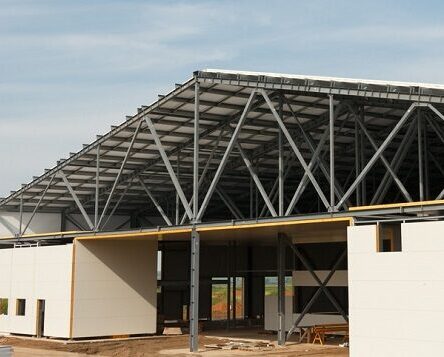
Workshops, production halls, manufacturing plants, factories - industrial buildings are very difficult to heat properly. They are often tall, have a huge area, are sometimes glazed in many places or partly open due to technological processes. Heating such areas is often quite a challenge and a huge cost. Can they be reduced?
What generates such large hall heating bills?
No matter what heating method is used in halls, they can generate high costs. Both air, gas, convection and infrared heating will not be fully sufficient if the building is not airtight or properly insulated. Large heat losses are generated by thermal bridges, leaky windows and open gates and doors. Maintaining a constant temperature in large-area spaces requires the use of an appropriate, modern building thermal insulation system, ensuring lower heating costs and minimizing heat loss.
Lower heating cost with PUR rigid polyurethane foam
The use of PUR polyurethane foam as an insulating material for industrial surfaces is a cost-effective, highly efficient way to retain heat in a building and reduce heating bills. The foam has a very low thermal conductivity of 0.023WmK, moisture resistance and dimensional stability. Thanks to its low thermal conductivity, the required layer of thermal insulation made of foam is thinner than that made of polystyrene foam or mineral wool.
The foam, in the form of rigid boards, fittings and profiles, has a consistent structure and uniform thickness over the entire surface of the insulation, so it is possible to maintain the same temperature throughout the volume of the building and create thermal comfort for all rooms.